

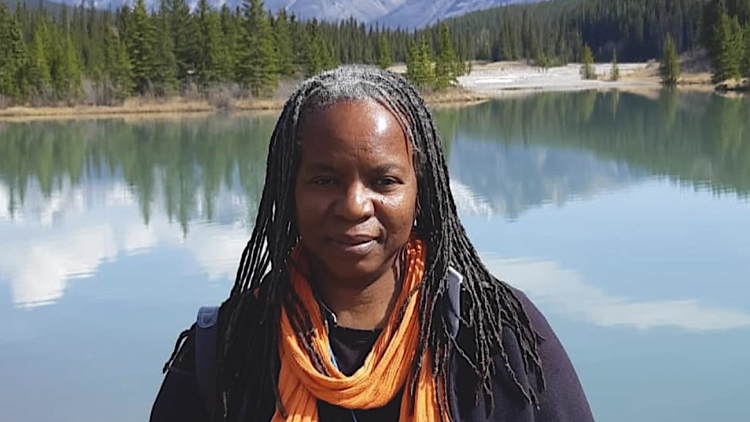
GreenLearning is committed to celebrating and amplifying Black environmental voices to provide youth from various backgrounds with a diverse set of tools and the knowledge that will enable them to become future green leaders. This mandate also involves supporting Black youth in the outdoors. We recently spoke with Jacqueline L. Scott — a scholar, writer and activist on race and nature to learn from her wisdom. We are deeply inspired by her research, which explores how to make outdoor recreation a more welcoming space for Black people. Keep reading to discover how she fell in love with nature, her thoughts on Black youth in the outdoors and what she thinks educators can do to make environmental learning more inclusive for them.
As a young kid who was always into reading her books, Scott didn’t always love the outdoors. She grew up in England and never did anything nature-related. In fact, she fell into outdoor recreation by accident after hearing about an organization that organized camping and canoeing trips. By then, she was already an adult and when she decided to give one of those trips a try, it was out of sheer boredom. On her first trip she fell in love with the outdoors and hasn’t looked back since.
Today, Scott has visited every park, conservation area and trail within a four hour radius of Toronto where she resides. And in all of those instances, she observed that she was always 99 per cent the only Black person there. This observation eventually inspired her to pursue a PhD at the University of Toronto, Department of Social Justice Education. Her thesis is on race and nature in the Great Canadian Outdoors.
“I wanted to discover what it was about nature and the outdoors that didn’t appeal to the Black community,” says Scott. What she discovered is that nature and the outdoors in Canada is very racialized and hasn’t always been welcoming to people of colour. In a sense, what she was really studying wasn’t just about race and nature in the outdoors, it was the relationship of Black people to Canada and its lands.
When asked about the challenges she has faced as a Black person in the outdoors, she explains further, “When in the outdoors, there is always this expectation that I must be lost. In the White imagination, Black people belong in the cities and so even when I’m in my full hiking or snowshoeing gear, I am thought to be out of place.” There is also the issue of dogs and the attitudes of dog owners who often have their pet dogs roaming off leash in hiking trails and ravines. “Any dog that’s off leash, barking and running towards me will always trigger fear,” she says. Another thing Scott points out is a challenge for most but not particularly for her is the information gap. For example, many people do not know that within 15 minutes of many GO Transit train stations, there is a trail. These are spaces that are available and accessible via the train service but many people do not know about them. Scott mentions leaving the city to explore nearby nature areas via these routes on what she calls “GO Train Hikes.” They are a fantastic day trip, far enough to feel special, but close enough to return home at the end of the day.
Two Black historical figures have shaped Scott’s journey. One of them is Harriet Tubman who in the 1800s, guided a large group of enslaved people to freedom in Canada. “Tubman was a phenomenal outdoor person with a special and exceptional ability to read the land. She understood the waterways and where they flowed, including how to hike at night, alone and while leading others.” Another figure that inspires her is Mathew Alexander Henson, who was the first person to stand at the north pole. He challenges the perception that Black people do not belong in the cold because they are from a tropical climate. In Scott’s words, “These are my heroes and they did it without Google maps!”
On Encouraging Black Youth to Love the Outdoors
Environmental education is incredibly important. Many teachers are sustaining optimism by framing climate issues in a way that lets youth know they can make a difference and that there’s a hope worth fighting for. Scott appreciates this and the way educators are spreading hope to young people. She also has a lot to say about practical steps educators can take in supporting Black youth in the outdoors.
Celebrate Black Voices
Canada is a multiracial society. According to Statistics Canada, 36.9 percent of the Black population lives in Toronto. And yet, there is a lack of diversity in the environmental sector. Scott believes that one way of managing this discrepancy is for educators to include Black and racialized representation in the stories they share about the environment, especially when it comes to green careers. “Black youth usually don’t pursue environmental careers simply because they hardly see themselves represented in the sector. They just don’t see a clear pathway,” she says.
Include Diverse Educators
Scott emphasizes how important it is for students to not only learn about the outdoors through a multicultural lens but also see educators who look like them teaching the topics. She encourages teachers to share detailed information about canoeing and camping trips with parents of Black youth in a way that answers their questions and assuages any fears. All of this can support Black youth in the outdoors. She adds, “Don’t just use the diversity to get more clicks and participation. Go deeper than that. Examples of groups that educators can partner with on learning experiences are Brown Girl Outdoor World which can take students on fishing trips and Colour the Trails which introduces youth to activities like hiking and mountain biking.”
Give Local Issues a Global Context
In Canada, climate change is often spoken about using a local lens but Scott highlights the benefit of including other global and multicultural contexts to frame the conversation and help draw in racialized children. Black youth in the outdoors need a balanced way of viewing the issues. “Educators need to make parallels between different regions of the world when teaching about climate change. For example, discuss the climate impact of the historic 2013 Calgary floods and look at the ones happening in India, as well as the cyclones in Asia and Hurricanes in Jamaica,” says Scott.
Start in Nearby Nature Spaces
Many educators are creating outdoor learning spaces as they see the many benefits for their students’ learning. Scott encourages educators to help Black youth in the outdoors to learn lessons by visiting outdoors spaces located nearby. Field trips to a local beach as a means to teach young people about watersheds or a nearby park can remind them that humans are part of nature, we need it and all have access to it via nearby nature spaces around our community. Scott’s word of advice for any Black youth who truly wants to embrace the outdoors is for them to “go and do it!” And this applies to whether they’re starting at the school yard or in the backyard (if they have one) or at the park in their neighbourhood.