

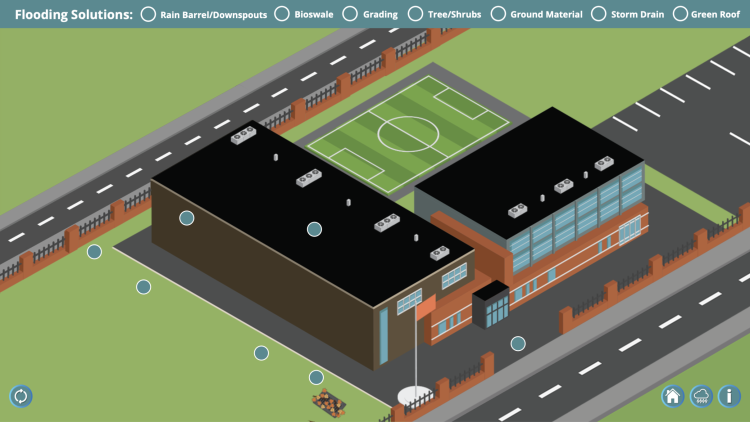
Have you ever wondered what happens in a school when the temperature increases and it rains or the snow outside starts to melt? Where does all the water go? How does all of this impact our local streams, rivers and oceans? Will all the melting snow cause a flood? Maybe your schoolyard gets very hot and you are curious about heating and cooling in and around school buildings. You may even be excited about starting a new school grounds project that’s environmentally friendly. Our simulator can help. Find out about being climate ready with flood science and get hands-on with our School Greening Simulator. It is a rich, immersive and interactive learning experience that will help you research and investigate solutions for flooding, heat and environmentally friendly school projects.
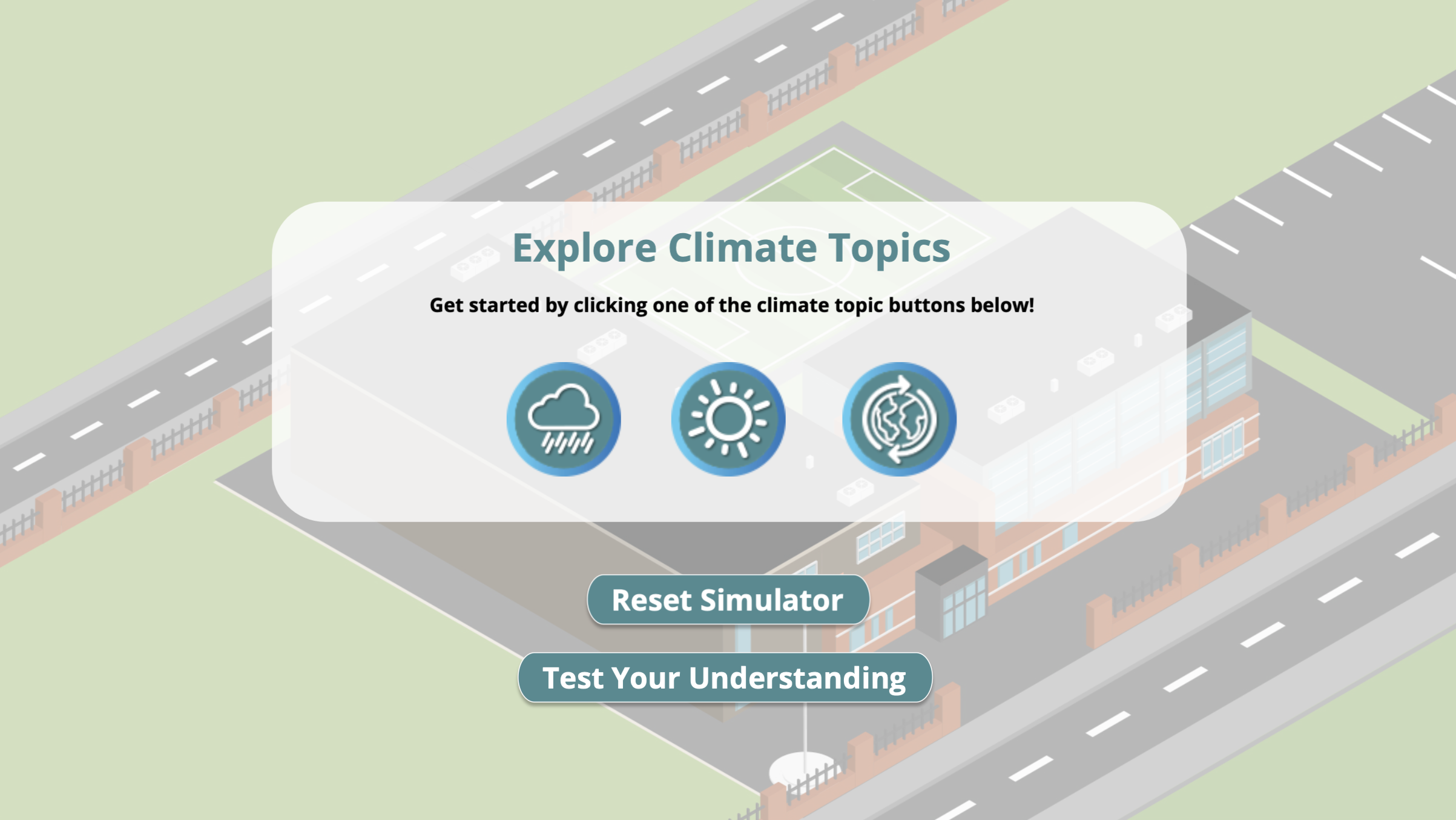
Once students are ready to get started, the simulator opens up to provide you with three clickable options to select your area of interest - flooding, extreme heat and environmentally friendly schoolyard projects. Students can toggle back and forth to go through the entire simulation and its related learnings or reset and start at the beginning again. At any time, they are able to test their understanding of the topics with a quiz.
Flooding
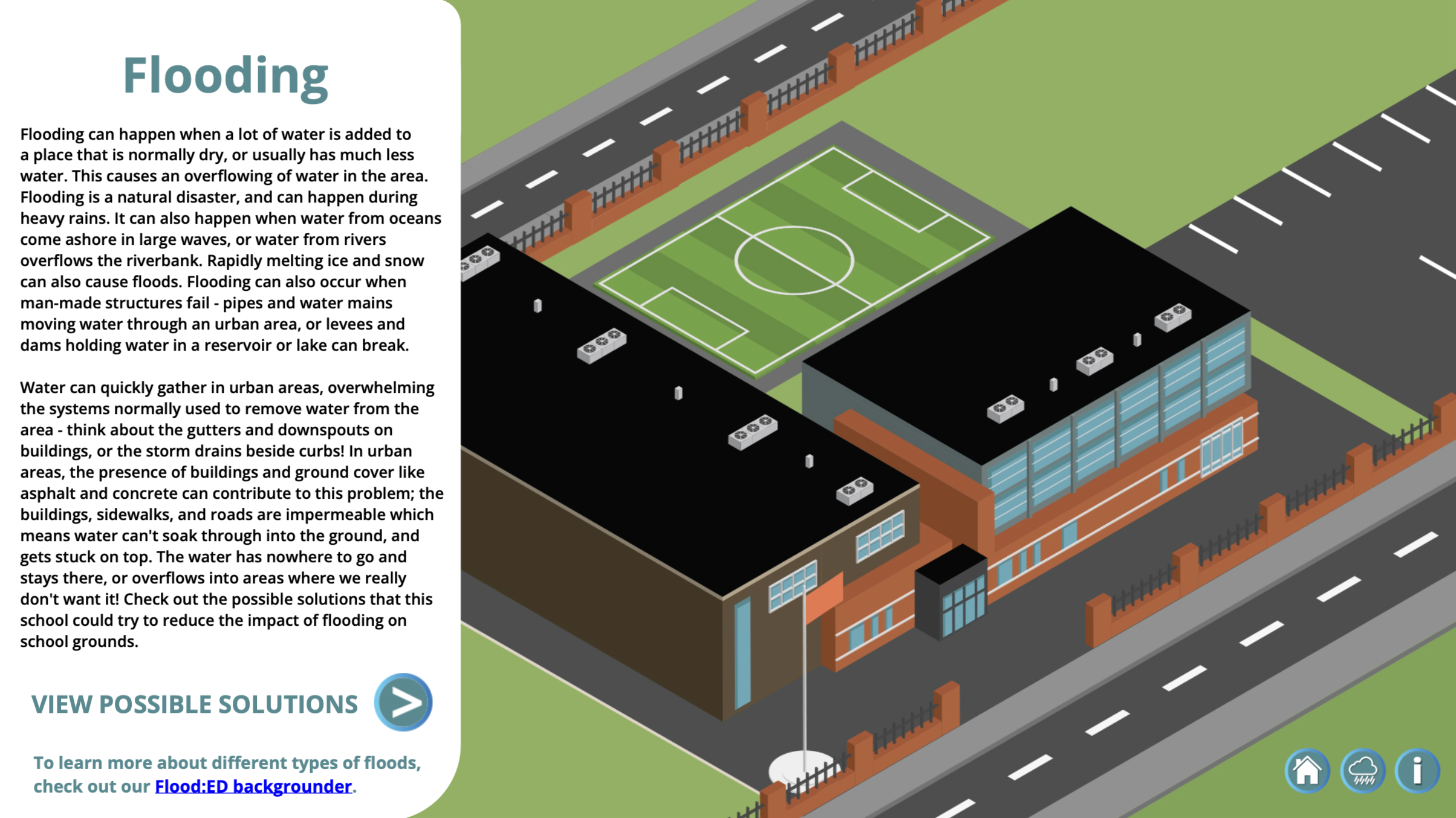
Becoming climate ready through flood resilience and addressing extreme heat can take many forms. We can develop plans and strategies to better prepare for floods, or we can take action to help reduce their impacts to create more resilient communities. As the climate warms, heavy rainfall events are becoming more intense and frequent which often overwhelms stormwater systems and in turn leads to flash flooding. Runoff from paved surfaces can erode soil and harm local waterways. Schools and communities face consequences from waterlogged fields, flooded basements, and unsafe conditions for learning and play. Nature-based solutions like rain gardens, green roofs, permeable pavement, and increased tree cover can aid in slowing down floods by soaking up storm water before it becomes an issue. The School Greening Simulator empowers learners to explore real world climate solutions by reimagining school grounds to better manage flooding and extreme heat. Through the activity, learners will identify and describe practical, local-scale solutions to reduce their environmental impact. They’re also challenged to respond to real-life climate scenarios and propose green infrastructure projects that could make their schools and communities more resilient.
Extreme Heat
As we face hotter summers and more extreme weather, it is clear that climate change is already affecting our daily lives. We believe that learners have a key role to play in building more resilient communities. Whether it is understanding how wildfires affect our ecosystems or exploring creative ways to protect our communities from floods and extreme heat, youth can be a part of real, local solutions. With the right tools and knowledge, we can all take steps to make our schools and neighbourhoods safer and more prepared for what the summer season brings. With the school greening simulator, learners are able to research things like shade structures, planting trees and shrubs and green roofs, including their usefulness for regulating temperatures on school property.
Environmentally Friendly Schoolyard Projects
Students can also explore other ideas such as rooftop solar panels, adding bike racks, school gardens/composting and starting an eco-club. After completing all three topics, learners will be able to:
- Identify and describe possible solutions to help reduce the local impact of flooding and extreme heat.
- Identify projects and initiatives that can be implemented on a local scale to lessen the environmental impact of a school or community space.
- Provide multiple suggestions in response to climate issue scenarios related to flooding, heat, and environmental impact.
And that’s not all. If you are looking for further learning opportunities that are related to the simulator, you can check these out.
Investigating Simulator Solutions
Now that students have gone through the simulator, they can start investigating at the junior or senior level.
Junior Level: Investigate real-world solutions to flooding and heat using the Flood:ED School Greening Simulator, then apply what you learn to design a safer, more climate-resilient community.
Senior Level: Analyze and apply climate adaptation strategies using the Flood:ED School Greening Simulator to develop informed, community-based solutions for extreme heat and flooding!
Hot Spot Investigators
In this hands-on STEM activity, students become environmental scientists, exploring how solar radiation impacts their local surroundings. Through data collection, analysis, and design, they will better understand how surface properties influence heat absorption and propose innovative, real-world cooling solutions for urban environments. As an optional extension, students could share their findings in an eCard, or test their results by building and placing solar ovens in optimal locations.
The School Greening Simulator is a great way to explore ideas for your school and community to take steps to be more environmentally friendly as well as being ready and resilient for climate impacts.